


Better Medicine, Better Business: Allied Analytic Launches Veterinary CBC ROI Calculator
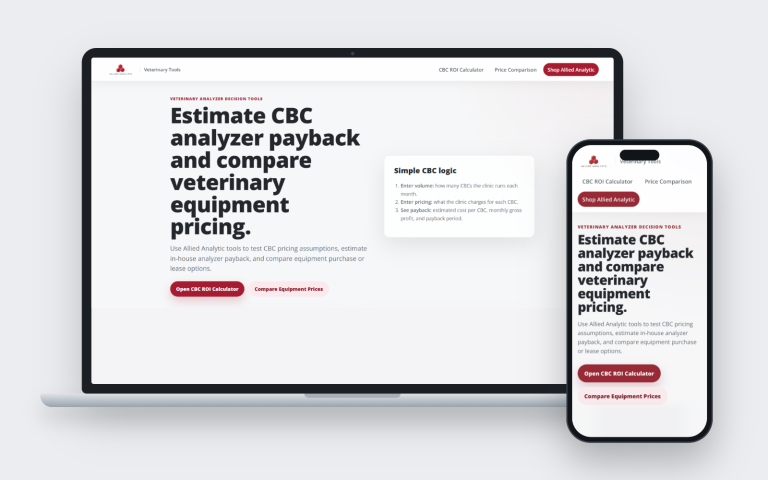
Caption: CBC ROI Calculator at compare.alliedanalytic.com
Veterinarians go into practice to take care of animals.
Veterinarians go into practice to take care of animals.
But somewhere between treating patients, managing employees, purchasing supplies, keeping up with rising costs and running a laboratory, they also have to run a business.
And today, those two responsibilities are increasingly difficult to separate.
For many veterinary practices, laboratory testing is a perfect example:
A practice sends bloodwork to an outside laboratory. The cost of that service rises, and eventually those increases have to go somewhere. The practice either absorbs them, reducing its own margin, or passes them along to the pet owner.
But what if there is another option?
What if a veterinary practice could perform more routine diagnostics in-house, receive results almost immediately, significantly lower its operating cost per test and create additional margin that can help support the rest of the practice?
That question inspired Allied Analytic to develop its new Veterinary CBC ROI Calculator, a free tool designed to help veterinary practices understand the economics of bringing routine complete blood counts in-house.
Veterinarians Are Entrepreneurs
For Jennifer Sineway, co-owner of Allied Analytic, the conversation isn’t simply about laboratory equipment. It’s about helping veterinarians recognize the business opportunity that may already exist inside their practices.
“Veterinarians have an enormous responsibility taking care of their patients, but they are also entrepreneurs, and the health of their business matters,” Sineway says. “When we can show a practice that something they already do every day can potentially become more efficient, more profitable and better for their clients at the same time, it can completely change the way they think about their laboratory.”
That realization can be particularly powerful with one of the most routinely performed diagnostic tests in veterinary medicine: the complete blood count, or CBC.
Practices may send CBCs to outside laboratories for years without ever calculating what bringing that testing in-house could mean financially.
The difference can be substantial.
What Does a CBC Actually Cost Your Practice?
The Allied Analytic Veterinary CBC ROI Calculator was designed to make that question easier to answer.
Rather than relying solely on generic industry averages, a veterinary practice can enter its own testing volume, client pricing and current laboratory costs to better understand the potential economics of performing CBCs in-house.
Consider a practice performing just 40 CBCs per month and charging $50 per CBC.
Using the calculator’s current example assumptions, an HM5C hematology analyzer is priced at $4,995. With a $650 reagent pack and an estimated 100 CBCs per pack, the estimated direct reagent cost is approximately $6.50 per CBC.
At that volume and client price, the calculator estimates:
- $2,000 in monthly CBC revenue
- $260 in monthly reagent costs
- $1,740 in monthly CBC gross profit before broader practice overhead
- An estimated analyzer payback period of approximately 2.9 months
- Approximately $15,885 after analyzer cost during the first 12 months
The example isn’t meant to suggest that every veterinary practice will see the same result. Actual results depend on testing volume, pricing, costs and other practice-specific factors.
The point is much simpler:
Every veterinary practice should know its own numbers.
What If Better Margins Didn’t Have to Mean Higher Prices?
This may be one of the most important parts of the conversation.
For a veterinary practice, increasing profitability doesn’t necessarily have to mean increasing what a pet owner pays.
Sometimes it can mean lowering the cost of delivering the service.
If a practice can significantly reduce its cost to perform a CBC, that creates options.
The practice can retain additional margin to support employees, equipment, facilities and other areas of patient care.
It may be better positioned to absorb future increases in operating expenses without immediately passing every increase along to clients.
And in some cases, improved margins may give a practice more flexibility to keep diagnostic pricing accessible—or even lower its price—while still maintaining a healthy business.
That is a fundamentally different conversation from simply asking how much more a practice can charge.
“Veterinarians shouldn’t have to choose between running a profitable practice and keeping care affordable for their clients,” Sineway says. “If we can help them lower the cost of delivering diagnostics, get answers faster and create more margin without simply raising prices, everybody wins—the practice, the pet owner and ultimately the patient.”
The Value Isn’t Only Financial
The ROI calculation tells an important part of the story, but not all of it.
Performing a CBC in-house can give the veterinary team access to results while the patient is still at the practice.
For a sick animal, a pre-anesthetic patient or a case requiring a timely clinical decision, that can be extremely valuable.
Instead of collecting a sample, sending it out and waiting for results, the veterinary team can potentially evaluate the CBC during the same visit and determine the next appropriate step sooner.
That creates value that doesn’t appear neatly on an ROI report.
It can mean a faster answer for the veterinarian.
A faster answer for an anxious pet owner.
And most importantly, a faster answer for the patient.
The Goal Isn’t to Replace the Reference Laboratory
Reference laboratories remain an important part of veterinary medicine.
Specialized diagnostics, pathology, confirmation, expert review and many other tests are appropriately performed outside the individual veterinary practice.
The opportunity isn’t about replacing every send-out test.
It’s about determining which diagnostics make clinical and financial sense to perform in-house.
For a routinely performed test such as a CBC, the economics can look very different once a practice actually runs the numbers.
And money retained through efficiently performed routine diagnostics can help support the other parts of a veterinary laboratory and practice that don’t necessarily generate the same margin.
Why Allied Analytic Built the Veterinary CBC ROI Calculator
Allied Analytic has spent years working with veterinary practices, universities, research institutions and other organizations using veterinary diagnostic equipment.
Through those conversations, one thing became increasingly clear: many practices understand the clinical benefits of in-house diagnostics but have never been shown the business case in a simple, transparent way.
So Allied Analytic built a tool to help them do the math.
The Veterinary CBC ROI Calculator allows veterinary professionals to adjust the assumptions to reflect their own practices and estimate factors including:
- Cost per in-house CBC
- Gross profit per CBC
- Monthly CBC revenue
- Monthly gross profit
- Estimated analyzer payback period
- Break-even CBC volume
- 12- and 36-month profit estimates
- The effect of different client prices on profitability and payback
- The potential financial difference between outside-laboratory and in-house testing
The assumptions are adjustable because every veterinary practice is different.
A small independent clinic shouldn’t be expected to have the same economics as a large multi-doctor hospital. Testing volume, client pricing, reagent expenses and current laboratory arrangements all matter.
The goal isn’t to tell a veterinarian what the answer should be.
It’s to give veterinary professionals the information to find their own answer.
A CBC Can Be More Than a Cost Center
Laboratory testing is typically viewed as a necessary expense associated with practicing medicine.
But routine diagnostics performed efficiently in-house can potentially become something more: a way to improve patient care while strengthening the economics of the practice.
That matters in an environment where veterinary professionals are simultaneously managing rising operating costs and trying to keep care accessible to pet owners.
A healthy veterinary practice has more resources to invest in its people, its laboratory, its equipment and its patients.
“Ultimately, this isn’t about selling a piece of equipment,” Sineway says. “It’s about helping veterinarians look at their laboratory differently. They already have the enormous undertaking of caring for their patients every day. If we can help them get answers faster, operate more efficiently and build a healthier business at the same time, that’s what this tool is really about.”
Better Medicine Needs a Healthy Business Behind It
Veterinary medicine is both a profession and a business.
Those two things don’t have to work against each other.
When a practice can reduce the cost of delivering a service, receive diagnostic information faster and create additional margin, it can strengthen the business without relying solely on higher prices to do it.
For some practices, the financial difference may be modest. For others, bringing routinely performed CBCs in-house may represent thousands of dollars in additional annual margin and an equipment investment that can potentially pay for itself within months.
The only way to know is to run the numbers.
Find out what your CBCs could be worth to your practice.
Use the free Allied Analytic Veterinary CBC ROI Calculator to enter your practice’s testing volume and pricing and estimate your cost per CBC, monthly gross profit and potential analyzer payback period.
Try the Veterinary CBC ROI Calculator
Calculator results are estimates based on user-entered information and assumptions. Actual costs, testing volume, revenue, profitability and equipment payback periods will vary by practice.